Friday, 6 July 2012

To Falmouth, for Orders*

Vagabond and the scribe were re-united on Monday night – the weather was so foul that I erected the tent for the evening and stayed snug underneath it whilst it rained in torrents. The forecast said it would clear by Tuesday morning (4th July**) and the wind would be Beaufort 4 – 5 from the SW then backing towards the South.  Our destination was Falmouth, more or less due SW of Plymouth. To catch the tide westward, we would have to leave at 08:00.
I woke at 12:15, 02:15 and every half hour (or so it seemed) and finally at 5:15, just in time to catch the first weather forecast of the day. It was unchanged. It was raining. I felt awful. I had breakfast and still felt awful. “B!!!!r sailing”, I thought and went back to sleep waking about 5 hours later, feeling much better.  The sun was shining. “Never mind the best laid plans, let’s go” I thought.
Well, with one thing and another, we didn’t cast off until midday. The wind was still SW, so we sailed more or less due South for an hour, as the Eddystone lighthouse loomed larger and larger. We were following a Grey funnel line frigate of some sort *** and then were chased by a Brittany Ferry. 'This is getting tedious', I thought.
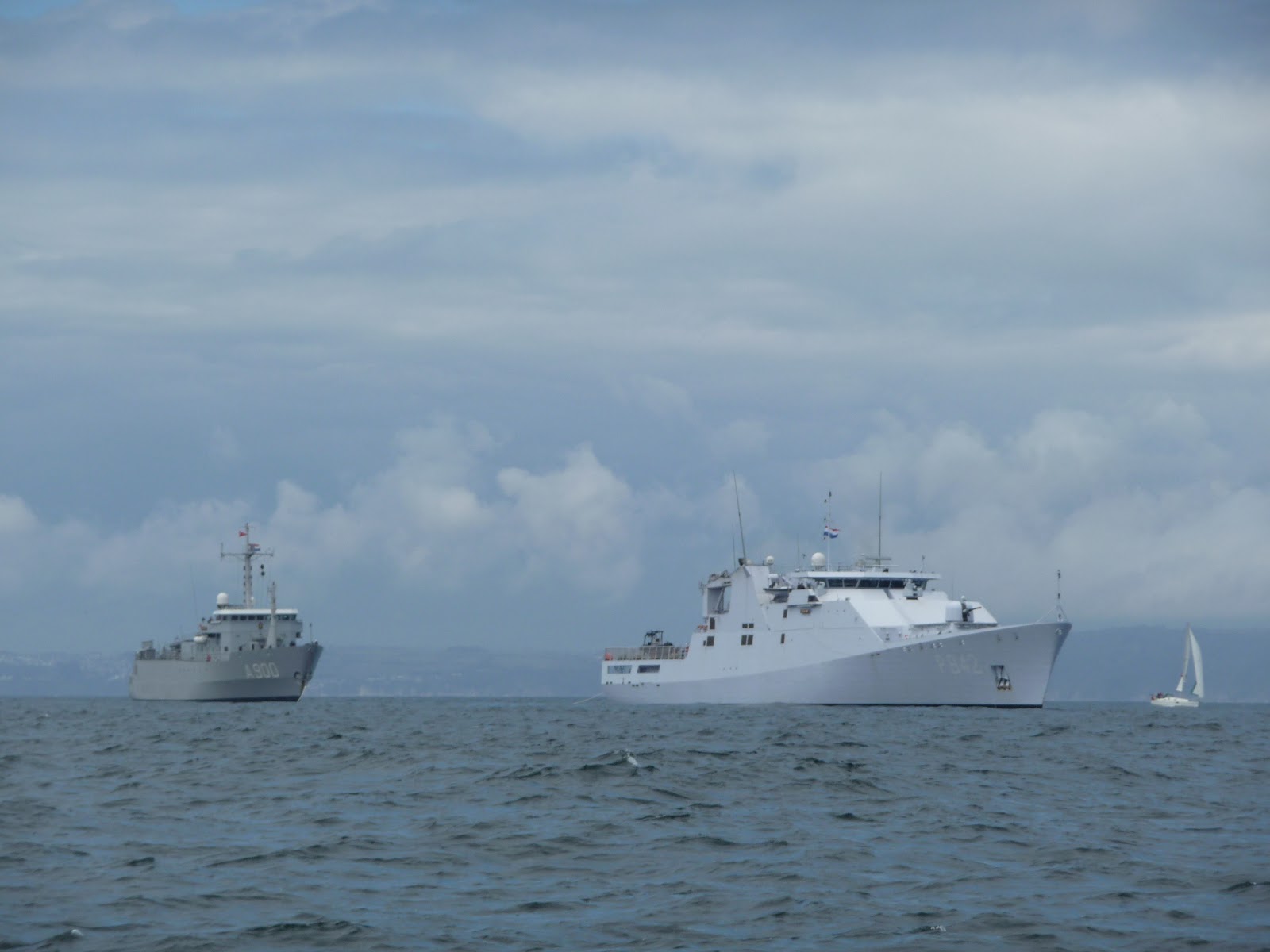
Let's all play at towing
So we tacked to the West, assuming that, when the wind went round to the South, we could angle more to the SW and reach Falmouth on one long tack. We came across other “Grey Funnel” line vessels (this time Dutch and German, who seemed to be playing at taking each other in tow. Other yachts seemed to be going my way and the coast of Cornwall went past on our starboard side, a mixture of green slopes, rocky cliffs and sandy beaches, dappled here and there in sunshine. Needless to say, the sun shone continuously to those of us at sea.
A message came over Channel 16 in English with a light accent “This is the German warship (I didn’t catch the name) – ve are about to open fire.....” There was then a loud bang and a grey shape on the horizon was surrounded by discharge smoke. Two fast jets (Tornados, I think) screamed over head and did complicated figure of eight manoeuvres for several minutes and then disappeared into the haze in the West. The Nato navies were playing together.

The coast of Cornwall slid past


I don't like the way the tide is flowing

At last - the entrance to Falmouth
Vagabond was enjoying herself, ripping along in the fresh breeze at just about 6 knots (some of which, she has to admit, was due to the tide. By about 5 o’clock, we were half way and there was no evidence that the wind was going to shift to the south. We were tracking too far north and would have to tack. Thunderclouds piled over the land ahead of us and our speed had slowed to about 4 knots as the tide changed. Had I left at my planned time, it would still have been with us.  To add salt to the wound, we were now off St Dunstan head, which as concentrating the tide as it rushed past. Tacking here and it would have pushed us backwards.
On came Freddie to punch us through the current; he stayed on until we entered Falmouth. At last we were in the “visitors” harbour, rafted up on the end of a pontoon, having met (and missed) two merchantmen and a tug towing a lifting rig in the entrance! It started to rain.

Day off tomorrow.
 * In the days before steamships, Falmouth was the first English port of call for merchant and RN ships. The first time Owners (and the Admiralty) knew that their ships had safely come to England was when a message arrived to say they arrived at Falmouth ( a messenger on a horse could get to London from Falmouth much more quickly than the boat). They would leave their orders for the ships at Falmouth so the phrase entered the English Nautical lexicon.

**Note for non-US readers – this is “Independence Day”, at the end of the war between the fledgling US and the Brits. It’s all the fault of one of the Georges (Kings of that name), but which one I can never remember.
*** This was from the British version of the Grey funnel line: HMS something or other


Sunday, 1 July 2012

Plymouth, Bilge Pumps and a map

Vagabond is now resting in the Mayflower Marina in Plymouth, whilst another tranche of strong winds go through. It seems to happen each weekend but at least it means that I can take the Owners Agent out for the evening. This time we went to an Open Air concert at a local Nation Trust Property. It was cold and damp. We sat huddled on picknick chairs under layers of clothing and blankets. all we needed was a wheelchair each to look like geriatrics. Perhaps the Estate Agent wasn't that wrong when he described the Owners Agent and your scribe as an 'Elderly Couple'!

Back to sailing. On Wednesday I was joined by the Civil Engineer (rtd) and we had a down wind sail (in mist and fog) from Salcombe to Plymouth.

In the morning, I had taken Vagabond off the buoy and tied up on the short term pontoon in the harbour, to get a few Amps into the batteries (I had to charge the Navigation Ipad in The Ferry Inn the night before) so getting the crew on board was easy. We left just after lunch and went down the channel to the sea. Clouds hung on the hills around Salcombe and mist hung over the sea. Past Stairhole bay, we found the Easterly wind, dispensed with Freddie and sailed. The coast lurked to starboard in the gloom. Photographs would be a waste of electrons. Suddenly a burst of sunlight would illuminate a field or two and then the gloom would return.
The wind died. We started Freddie. Freddie died.
Help!
After a little attention (and a lot of swearing) Freddie was restored to health.
The wind returned, and strengthened so Freddie was silenced again. As we were sailing downwind, the CE (rtd) was curious to learn what happened to the boat if the ballast tanks were emptied. The bilge pump was switched to "empty tanks" and hands were applied to the bilge pump. The water level in the tanks went down and then the bilge pump stopped working.
It's a good thing we weren't sinking.
The weight reduction made a difference to the acceleration rate of the boat. A brief puff of wind and we were off...
And we stayed that way, passing the entrance to Newton Ferrars and the Great Mew Stone and on, into Plymouth Harbour. A foreign Frigate sulked in the distance to the West and a fleet of racing yachts dashed about to the East as we sailed on to the Marina to recover and investigate the Bilge pump failure. This required the removal of the pump; a task that really required the boat to be turned upside down. As you can imagine, this was impractical and your scribe acquired a severe crick in his neck. Disassembly of the pump revealed some (builders?) debries trapped by one of the pump valves and prevented it from closing.

One (the only?) of my readers (the Flautist) suggested that a map of the trip so far would be useful. So here's one showing the "bottom" of England, with blue spots showing where we have been. The trip reads from right to left (so far).

Route map so far......


Saturday, 30 June 2012

Over the bar (Tuesday)


The morning in Dartmouth was foggy, breezy and wet. We were clearly in very low cloud. Slowly, the cloud lifted and by about mid morning the cloud base was about 100 feet above sea level. A steam whistle sounded and the Dartmouth  Railway steam train arrived. 

We had to cross the tracks to get to the showers (8 out of 10).

Steam buffs delight
Midday passed and the cloud base hadn't changed. I hailed a passing yacht - 'It's foggy in patches, quite smooth with a SW wind.' came the reply.
I wanted to take Vagabond to Salcombe that afternoon. The tide was right and the wind would be right once we got out beyond Start Point which lay to the South and West of us.
The tide and a few tacks carried us out of the estuary only to find the wind "right on the nose" as we ran down the coast towards Start Point, so we tacked away to the South out into the Channel to give us clearance of Start Point. It became apparent that the tide was still flowing up Channel, so we were sailing away from our destination. Not really what you want to do! We hastily tacked back towards the coast, our course now taking us North and West. But we still had to go South a bit to get round the Point. 

Tacking towards Start Point as it appears out of the gloom
 We found some tide running south down the coastline and tacked within it to keep as far West as possible whilst making progess to the South. At last, we squeezed ourselves past Start Point o find that the tide in the Channel was now taking us West. We still had Prawle Point to pass and then the coast ran away to the North West towards the entrance to Salcombe. The fog closed in - we could just see the lower few feet of the cliffs about half a mile away to starboard but it was impossible to guess how far we could see out to sea. There were certainly no other craft in sight.
Prawle Point
The fog horn at Start Point boomed every minute. I anxiously scanned the sea and watched the AIS receiver for warning of ships. Vagabond has no Radar reflector, so we have to rely on my Mk 1 eyeball and ear combination for collision avoidance.
We passed Prawle point into a very steep set of seas.
By now the tidal stream had bult up and we were experiencing the rough water that forms in tides downstream of a headland. I closed the land to try to get out of the worst and we crept along the coastline.

Salcombe entrance at last
 The fog cleared up a bit just in time to see the entrance to Salcombe. I realised we were a bit close and likely to attempt to cross the bar if we were not careful. This has a fearsome reputation for wrecking the careers of skippers (and their craft) and is rumoured to be the inspiration of the Tennyson poem "Crossing the Bar." I edged to port so that we could make our route into Salcombe right on the Western side of the Estuary.

We called up Salcombe harbour master. 'Orange Buoy No 17, just astern of the Halberg Rassey', he said. We've got to pick up a buoy for the first time, just behind one of  the "Roll Royce" yachts. Ouch. In the end it was remarkably easy. That's the advantage of being in a cockpit that is only about 600 mm * above the sea. You can reach buoys as they go past, without worrying about things like boathooks. In no time at all we were fast to the buoy. Six hours. The harbour master rushed up in his launch, took £15.00 off me for the fees and said 'You can relax now'. Not quite. I have to tidy up first for I have a crew arriving tomorrow.

Salcombe in the evening from a buoy.


Tuesday, 26 June 2012

Dartmouth

I have always enjoyed sailing into Dartmouth; the entrance is almost hidden from the sea and slowly unfolds in the sunlight as you approach. Sadly, the sun was in short supply on Monday. To catch the tide we cast off from the pontoon in Brixham early in the afternoon. There was little wind and we drifted out of the harbour and pointed towards the English Channel.

The Headland that protects Brixham


Once clear of the headland that protects Brixham, we found the wind - directly against us. I suppose this makes up for the downwind sail that we had from Portland. Several pretty craft were sailing for Brixham - I wondered what they knew that I didn't!
Unwilling to motor the 9 miles to Dartmouth, I set Vagabonds nose out to sea and we went off. It started to rain and did so intermittantly for the next three hours.
Several yachts motorsailed past us.


Motor sailing!
At some point in the trip we did 8 knots (according to the GPS). I wasn't really aware when this was, as I spent all my time concentrating on keeping us going, as close to the wind as we could.
At about half way there was a frission of excitement. A Mayday call from a vessel that was taking in water - in Chichester harbour entrance. Yachts standing by, helicopters summonded, harbour launches to the rescure, all cordinated ver firmly by the Portsmouth Coastguard. The situation was over in an hour - the vessel had been  taken in tow and the crew / passengers taken ashore; the airwaves returned to normal. Vagabond forged on regardless.

The Mew Stone
Several tacks later, we came abreast of the Mew Stone and were able to run to the Dartmouth entrance. Despite the conrary wind, we arrived early. The whole of the Dart river was emptying into the English Channel.


Dartmouth Entrance in the Gloom

Despite full sails, we were doing less than 1 knot over the ground as we went though the narrows.
On came Freddie, down came the sails and we motored into Dartmouth, just in time to see the last Steam Train of the day depart!

A quick glass of wine at the Royal Dartmouth Yacht Club, leaving an undecypherable signature in their visitors book. A discussion on Viral marketing with barman and then back to Vagabond for a fish supper on the quay.

Mussel supper on the Quay


Sunday, 24 June 2012

Beyond the Bill

Next stop was to be somewhere on the West side of Start Bay. This meant getting past the dreaded Portland Bill without being caught in the tide race. We had to be at the tip of Portland Bill catch the tide as it turned to the West. We could then creep close to the ‘Bill provided that the wind (a) not strong and (b) not from the anywhere between South and West. Otherwise it meant adding another 10 miles to the 45+ mile journey, as we would need to several miles offshore of the ‘Bill to miss the tide race.
 June 20, Midsummer day. I woke at about 05:15 and was just in time to catch the shipping forecast on my mobile phone – a first in terms of both technology and mental state at that time in the morning! The  forecast seemed almost too good to be true for the crossing. Wind Easterly 3 -4 freshening to 5 in the evening, with rain by 17:00. The trip should be about 45 miles – 9 – 10 hours. Leave at 09:30 to get to the Bill on time and then rush off with the tide.
Make sandwiches. Pay the bill. Prepare for sea (boat and me).  We needed to be at the tip of Portland Bill by about 11:30 to catch the tide. Cast off at 09:30. Call up the harbour master on Channel 14 to see if we can use the middle entrance. No joy. We have to use the Eastern entrance which makes our voyage at least a mile longer. Ignore regulations about using only the motor in the harbour. Hoist all sails and cruise diagonally across the harbour (it is empty after all) and tack through the East entrance. My timing must be about right, there’s a convoy of at least 10 other yachts strung out behind and ahead of us, running down the side of the coastline. There's also a fishing boat that seemed intent on getting in my way.

Determined to lay his pots....


Let's form a convoy!
Pass all the abandoned Portland stone quarries and their rusting derricks. See spinnakers hoisted on the larger yachts ahead as they round the Bill, accelerate and start to disappear towards the West.
At the Bill at 11:20 – brilliant! Turn on to course to find the wind is directly on the stern. Vagabond’s favourite mode of sailing (not). The sea is too unsettled to repeat the goose wing trick of the Solent. After a few minutes futile efforts to get the jib to set with the wind directly astern, I realised I would have to “tack” downwind. Reasoning that by the time I reached the far side of the bay, the tide would turn and push me north towards land, I choose to tack off the course to the south. It wasn’t a question of following a compass course, it was a question of steering a course to keep the sails set and without unintentionally inducing a gybe.
The fleet spread out – those with Spinnakers following the direct course, others electing for the northerly or southerly “tacks”. We flew along (aided by the tide) at over 7 kn. After about an hour, the sea started to become much rougher, with unpredictable wave patterns and I realised that the course had taken me into the northern edge of the tide race that was streaming SW from the ‘Bill. We gybed (intentionally) to run further on the northerly “task” and were soon into more predictable conditions After about half an hour on this tack we gybed again to resume our original course. The wind was starting to freshen. A few White Horses appeared. Then more raced past us as we seemed to surf along between the wave crests.
And that’s how it was for about six hours (apart from heaving to for a spot of lunch). No photos, because the land was so far. No wildlife. Just sea and sky.The sky looked lowering, so the wet weather gear was donned. A small light shower of rain fell for  half an hour and the sun reappeared. A container ship appeared crossing my path and that of the yacht a couple of miles ahead.  I though it would cross our course between us – it must have been huge because it crossed well in front of our “leader”.
Around five o’clock, we were 3 miles south of our track and I thought it was time to turn northwards to regain it. The wind now seemed to be nearer force 5 than 4 (there were streaks of foam starting to appear on the water); it seemed wise not  to risk another gybe, so we turned round into the wind rather than allowing it to cross our stern.  During this manoeuvre, I realised how strong the wind really was; had we been beating into it, We would have to had at least one reef in the main to be comfortable.
We carried on with all sail, consistently achieving a speed over the ground of more than 6 knots, with the  track taking us in almost the right direction. At 18:00 (a little later than forecast), it started to rain. Not English gentle rain buttropical “beat you into submission” rain.  And it kept it up without let up until we arrived in Torbay. I had had enough. Brixham was the nearest port of refuge and I could just make out it’s lights (even though it was only 7 o’clock) through the gloom. Turning into the wind, I started Freddie, lowered the sails and more or less felt our way into the harbour. We found our alloted berth, secured Vagabond for the night and put the kettle on. I was wet through, but at least it was with soft fresh water.
The weather for the next couple of days looked foul, so I decided to return to home, take the Owners Agent out for dinner and assist with both house hunting and house clearance. It’s amazing how much stuff has accumulated in the 39 years we have lived in the place. Houses viewed from the roadside: 4. Houses viewed from the inside: nil

Brixham is quite a pretty place - in the Sun!

Thursday, 21 June 2012

Olympics here we come

I had intended to stay in Poole for a couple of days. The next day, early in the morning, I went off to find petrol (Petrol* stations are increasingly difficult to find when walking and you can't really carry a can on a bus) so I had a long walk. I returned to Vagabond to notice that the wind was Easterly. Not what was originally forecast. A quick down load of a GRIB file confirmed a slight change to the wind forecast: Easterly at first, veering  to the South after midday.  Just what we needed to get us to Portland. Already it was warm and it would be hot in the cockpit with a wind abaft the beam. Shorts would be the order of the day.
There was a hint of cumulus clouds over the coast line to the South West.
“Sea Breeze will set in” I thought, “let’s go”.

By now it was about half ten; the sandwiches and mid trip coffee were made in double quick time and we were off.  I started tacking along in Poole harbour but thought this was wasting time: we needed to get to the sea.  
“The wind will be OK in the entrance channel, and if not there it will be fair once round Saint Albans head, so I’ll be able to sail most of the way. Besides , we had to catch the tide round the various headlands on the way.

On came Freddie; he stayed that way until we reached Portland seven hours later. The wind proved non-existent once we reached the end of the channel from Poole, although some lucky people were drifting in.
Drifting slowly in...
It wasn't any better when we had rounded St Albans head.

Old Harry

So, hugging the coast we went past Old Harry, past Swanage and round Anvil point and heading out to sea a bit to miss the tide race of Saint Albans Head. We then aimed across the great bight between St Albans head and Portland.  Crossing the tide race at St Albans was interesting, for, although We were at least 3 miles off shore (the recommended distance) – we negotiated breaking waves, unpredictable crests a d troughs and, once through,  a  thoroughly confused sea for a mile or so. Nearer the shore, I could see a line of breaking waves.

Layers of Dinosaurs

We saw the Jurassic coast in the distance (this is where dinosaur fossils were first identified as such in the 19th Century) and motored on. Almost, but not quite, in company with a few other yachts. Young Guillemots scooted out of our way, diving if they thought we were too threatening.

Despite being so far off shore, in my attempt to head “straight” for Portland, we obviously were into the gunnery range off Dorset, for the range safety boat rushed up and chivvied us further out to sea. The Isle of Portland emerged above the horizon to the West and then, at last, Portland harbour hove into sight. It’s vast and it took ages to approach it. I’ve found this every leg so far, the approach to the end takes ages. You think the voyage is nearly over and it’s at least another three hours before you’ve stopped.

Once inside we chugged across the harbour (an enormous man made enclosure, about 2 miles square, 30 feet deep, built between the Isle of Portland and the mainland, using Chesil beach as the Western barrier. Just imagine how it must have looked when we really had a real Navy. We followed the marked channel (which goes round two sides of the square) to try to avoid all the dinghies harbour to reach the Marina. None the less we came within 3 metres** or so of a couple of boats bearing the team GB logo as we wanted to different ways round the same buoy. But we missed each other........ I was tired and slightly deaf; my knees were red. The Marina in Portland is vast – I assume it will be full at the Olympics – the snag is that there is no real infrastructure beyond one bar, where I supped a pint of ale whilst watching the light change on the moored fleet. 
For the record, Vagabond was “parked” 500 double paces along pontoons from the shore exit (that’s about half a Roman mile). ***
 I suppose I should really have gone on to Weymouth Town...
For my transatlantic readers 
* Gas   
 **10 feet (imperial / US)
For non Classic Roman readers
***0.5 miles  (Imperial/US), 800 m (metric)


Bound for Poole


Yarmouth in the morning sun

The rain overnight had cleared. It was time to be on our way.  At 09:30 on the following morning, we set sail for Poole. The sun was shining and the wind was from the South West, directly up the Needles Channel.  The forecast was that it would back to South later on.

Leaving Yarmouth (and it's ferry) in the morning sunshineRather than tack in this tideway, we motor sailed out, disdaining the coastal channel to slide past all the gravel grounds on the West of the Channel to the last buoy in the sequence. I thought this would put me in a good position for a long tack to Poole entrance. I was in the company of several other yachts, (well, being overtaken really) and they all tacked off to Port, making for Cherbourg or the Channel Islands. For a moment I was tempted but sense prevailed and we turned to starboard and flew along at 6 knots (speed over the ground) due West.

Leaving the Needles astern

 So we left the Needles astern.

You can tell when Vagabond is flying along; her wake chuckles with delight. It was a glorious morning. The sun shone on the Needles and the cliffs to the south of the IOW. A flight of Guillemots swooped over the bow, flying low in company with us.  They remind me a bit of puffins, their flight seems a triumph of optimism over poor aerodynamics. A lone Gannet plunged gracefully (but, as always looking a bit disjointed on entry) into  the sea off the starboard bow and emerged with a fish struggling in its gullet.
Away in the distance we could see the beach huts at Mudiford (one sold for more than £140,000 this week - good views, no services) and then Christchurch and the houses and flats of Bournemouth.
We hove to for lunch and then resumed out Westward progress. By about 3pm, we had to tack once, to bring us south to the entrance to the Poole Channel.

We suddenly met traffic - a fast Ferry and a lovely old timer.


Here I made a mistake. As the wind seemed to have shifted to blowing up the channel, I dropped the main and drifted up the channel on the minute jib. It took forever and the tide had turned so that Poole harbour was starting to flow out through the narrow channel at Sandbanks. The b++++y chain ferry messed me up too, I had to do a full turn to avoid it and it’s chains. On came Freddy and he pushed us up against the tide to the Town Key Marina. We were both a bit exhausted by the time we reached it and I grabbed the first pontoon I could find. I was asked to move immediately, for a large, brand new, motor yacht had earmarked the pontoon and was even now manoeuvring into it from the shipyard some small distance away.
I looked round and realised that the posh Ferry was really this motor yacht. £11 million to purchase (as I found out later) and burning 1000 litres* of diesel an hour.
And I think my domestic heating bill is high!

Vagabond was allocated a much more menial berth that was quite tricky to get into. Once Vagabond was secure I went off to forage for food and find out where I could buy some petrol. Portland beckons.

* For my trans Atlantic readers, 100 litres is about 250 gal (US)