Tuesday, 23 October 2012

Moving and Navigating

As the dedicated reader may have gathered, the Owners Agent and I are in the process of moving house. And what a process. We know when we are moving, we know where we are going immediately and we know where we want to be in the longer term (not where we're going to be immediately). What we don't know is when we'll be at the end point.

Just to set your mind at rest, we are not moving into Vagabond whilst she is parked in the barn at Kings Ash Farm. (Not ever, I hear the Owners Agent asserting very firmly.)

As a bit of light relief, I have discovered that I have recorded most of the track that Vagabond follwed this summer and that I can display them on a PC. So now you can be amazed by this technology as I publish these tracks over the next few weeks. You can re-live each leg and refer back to the blog of the day!


The "Nav Station"- the scribble on the right is my passage plan of the day.
 
Firstly, though, a word on the instruments fitted aboard Vagabond. This photo shows the "Nav station" of Vagabond swung into the "under way" position. When at rest, the board can be swung into the cabin. In the middle of the trip (crossing from Holyhead to the Isle of Man to be exact)  I realised that this arrangement was a bit dangerous -  in really rough weather there is a real risk that the cabin could be flooded by a wave coming down the companion way.
I use Navionics software and charts running on my Ipad2 mounted in a waterproof case (the blue rectangle in the photo)  as the main source of navigation information. The Ipad2 includes a GPS and the Navionics software is excellent. There are three snags with this arrangement.

The first is that I have to rely on the internal Ipad battery power whilst it is in the waterproof case and this can be marginal if it's left on all day. I overcome this by making sure the Ipad goes to sleep after 10 minutes of operation (as it is in the photo) but this does mean that you can't record a track as the GPS loses position when the Ipad is asleep.

The second snag is that it is sometimes difficult to see the screen in very bright daylight. I overcome this by having the Ipad mounted on a quick release strap (Velcro!) so that I can take it off the board and put it into a shaded spot to read if necessary (it is tied on too!)

The third snag is that the Ipad does not communicate with any other instrumentation - I daresay you could do it using the wireless interface but that is (a) beyond my competence and (b) would use even more precious amps.

So I have a second GPS, the Garmin 620 already discussed. This serves as a back up to the IPad, as it takes its power from the main batteries and, as I have discovered, records the track.

It talks with the VHF, to give it the GPS details for the dreaded DSC Mayday call, and also listens to the radio information on AIS data from other ships. When the radio identies a potential "target", the GPS displays them and it shouts at you if they are dangerous. Usually this warning is very pessimistic and can be ignored once one has identified the target although it did make me wake up when one of those fast catamaran ferries snuck behind us near Poole.  

As originally fitted, there was a TackTick wind sensor at the mast head, communicating with a Tactick display. This also receives Sog and Cog from the GPS so can show both relative and true wind speed and direction. It's blank in the photo above, showing that the picture was taken after the sensor had been blown off.

Finally, there's a TackTick depth display. On a couple of occasions (when sailing very quickly) is has shown spurious results.

The ship batteries are topped up by a couple of solar panels mounted on the poop. I have not yet exhausted the batteries during a cruise but have only been away from shore power for a couple of days at the most.

Monday, 15 October 2012

Still here

Hello, dear reader.
No doubt you are wondering about the deathly silence on this blog, as it slips down the google lists.......
It's been a bit quiet on the Vagabond front on the last couple of weeks. I think she's still under her dust sheet, in the barn. She was last week, when I anointed all the scuffs and blemishes on the rubbing strip with varnish (well what are rubbing strips for, if not to become somewhat scruffy over a season?).

That's not much to show for a couple of weeks but my mind has been elsewhere. Literally for an hour or so one mornign a couple of weeks ago, although a supsequent scan assures me that I still have one ( a mind, that is) and the neurologist says it's nothing to worry about.

Meanwhile, the mind has been on line, the Owners Agent and Ihave been concentrating on this downsizing activity. This is not something we recommend after living in the same place of 39 years (and after recently acquiring a boat) One skip load has gone from the garage. A number of pieces of furniture have been ebayed for a song and we had a party last weekend at which we managed to give away a few knick knacks. A self store room has been filled and there is still more to go.

We become of no fixed abode as of two weeks hence - the Owners Agent refuses to take up my offer of B & B on Vagabond, so we are in a holiday let in the middle of Buckinghamshire (and winter approaches....).

Chin up - things are worse at sea (as my mother always used to say.....)

Friday, 21 September 2012

Boat Show Edition

Well, dear reader, I've just returned from the boat show at Southampton. A new wind speed instrument has been obtained, so in the next part of the voyage I can expand the nerd index of the posts and blether on about real and apparent wind speeds (until the whirly thingy falls off the mast again). Shopped out, I spent a few hours on the Swallow Boats stand, trying not to put off potential customers by explaining our progress so far (and promoting this blog!)

At times it seemed to be a Swallow Boats Owners club meeting. Hardly an hour passed without a current owner of  Bay Raider or Bay Cruiser turning up and chatting with Matt Newland (the boss) to find out what's new.   (The real one is called the Swallow Boats Association and it has it's own web site and forum http://www.swallowboatsassociation.com/).


The visitors seemed really interested in our exploits and, judging by the "hits" on the blog in the last couple of days, many of them (you?) have found us on the web!

Several urged me to call into see them up on my way round the rest of the UK next summer, including Ian Richardson, of Stromness, the designer and builder of this delightful wooden boat based on a traditional Orkeny working boat.


The sun shone, the breeze wafted past and several potential new owners were shown over the Swallow Boats on display.

I discovered that I had withdrawal symptoms and went to have a look at Vagabond today.

Despite being in a barn, Vagabond has become very dusty. I have now covered her with a large tarpaulin that I happened to have available. I've also made an A frame out of a couple of aluminium tubes from my old hang glider.*  The theory is that this should make it even easier to lift and lower the mast by giving a better mechanical advantage**  when hauling the mast up from the horizontal "derigged" position. I'll let you know next spring if it works!


* Airwave Magic 4, built in 1988 and scrapped in 2003 with about 100 hours on the airframe.

**technical term - the intention is that the rope used to hoist the mast will be led round a pulley on the top of A frame, thus pulling the mast UP rather than sideways.

Friday, 14 September 2012

Nothing to report

Vagabond is now under a roof in a barn not far from my home . Stripped of sails and mast she looks a bit dejected parked alongside cement mixers and fork lift trucks.

The rail and rubbing strip need varnishing, the rust streaks need cleaning off and Freddie needs to be serviced. At least I can do these winter jobs out of the worst of the weather. But in my usual style, I'm putting them off.....

Instead, I'm off to the Southampton boat show next week. The owners agent has said I can go and that she wants no part in it.

Who knows what will happen?

Tuesday, 4 September 2012

Winter Quarters

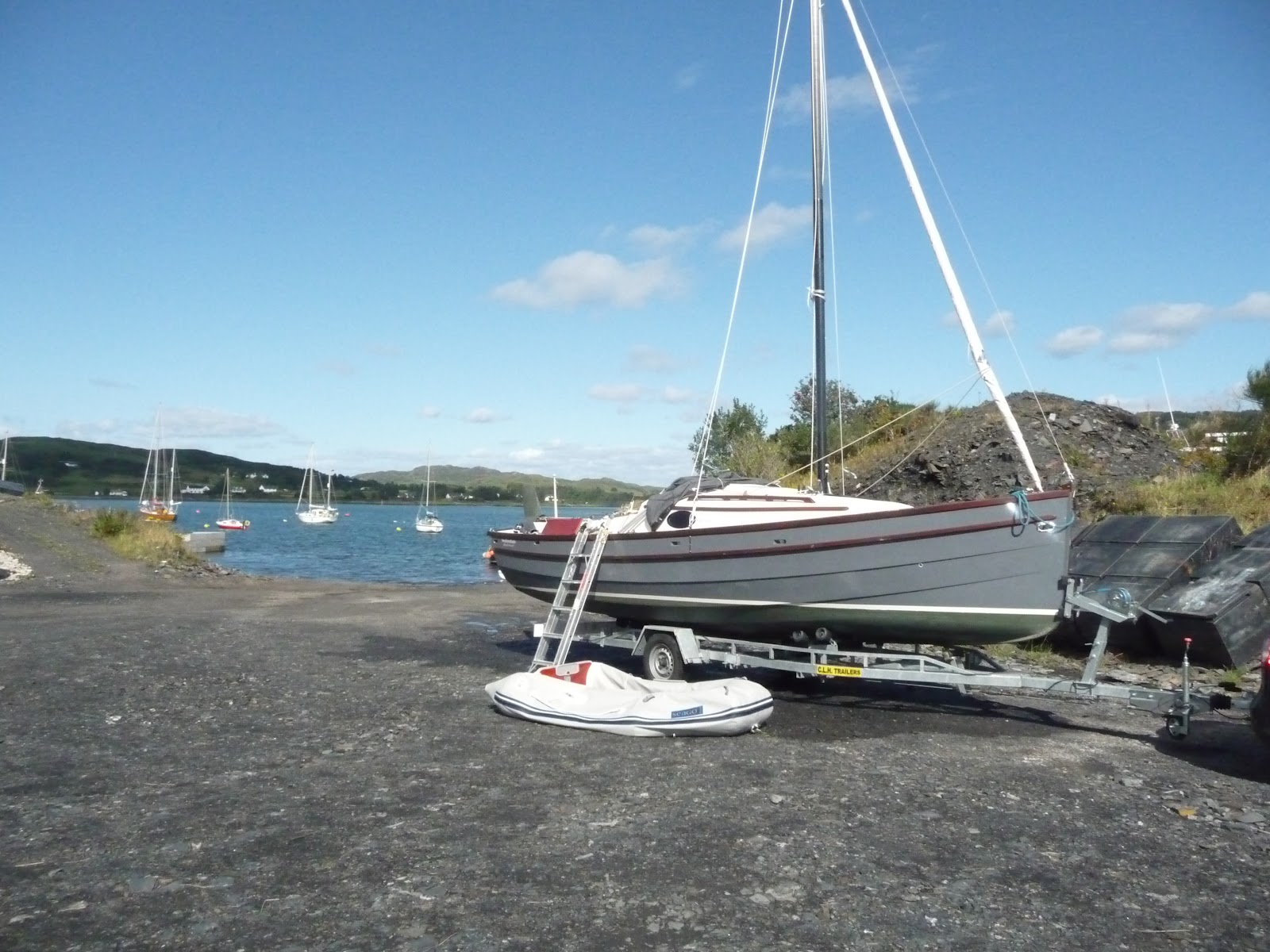
 Vagabond is now safely tucked up in her quarters for the winter: a nearby farm, neatly parked on her trailer between a pile of straw bales and a small builders dump truck. So now the various “works” that need doing to her can begin. Washing the salt off, scrubbing the decks, polishing the upper works and re-varnishing the woodwork are just the beginning of the list. Not to mention the cabin interior......
My readers (I now realise that there are at least four of you) will remember that I had left her on a mooring at Balvicar on Seil Island, just south of Oban. I was on a three line whip to be home for a wedding. With the help of the local bus, Scotrail and Virgin trains (not to mention the Owners Agent, who met me at a local station late at night) just made it.
The following week, I extracted the trailer from the local farm and headed north. The M6 was trouble free, the Vikings' widow kindly gave me lunch, and the we arrived in Balvicar late on the Wednesday evening.  The trailer was abandoned in the boat yard and I took the car away to fill it with fuel for the trip south.
The following afternoon, when the tide was rising, Doris took me out to Vagabond, Freddie was fired up (first pull even though he had been ignored for a week) and I brought Vagabond into the slipway entrance, to tie up alongside the jetty. The car and trailer were manoeuvred into position on the loose surfaced slipway. I pulled Vagabond so that her nose was nuzzling against the trailer rollers. Then the wind took charge and Vagabond was blown diagonally across the trailer centre line.
Much fiddling about with the anchor over the stern corrected this. Meanwhile the tide rose; the sea lapped around the trailer and approached the tow car.  I unrolled the winch tape and attached to Vagabonds' nose ring, the strain was taken up and I slowly pulled her out of the water onto the trailer. After what seemed like about 10 minutes of winching, she was sitting on the trailer and I was seriously pleased that I had emptied the ballast tanks on the last sail.
Now came the task of moving the car and trailer up the slipway before both were engulfed by the tide. The slipway surface was loose slate. The tow car has front wheel drive and the first attempts to get the ensemble moving were disasters. The wheels slipped, the anti skid system came into play and the whole lot just stopped.  I reasoned that the trailer wheels might have become embedded a bit in the surface, so uncoupled the trailer and moved it back (down slope) a bit (I couldn’t move it up the slope). Pulling in the stern anchor seemed to be a good idea too....

Out of the water with Doris deflating!

When I re-coupled the trailer to the car, I turned off the anti skid electronics and, with my heart in my mouth, gently turned on the power (it’s an automatic). The wheels slipped and then gripped and, with some wheel slip, we moved up the slip away from the water.
She’d been in the sea since May and was weed and other growth free – the CopperCoat, though green, clearly did what it said on the tin.
Two hours later, Vagabond had been de-rigged, Doris deflated , and we were on our way south. Planning the journey was a bit like planning one of the voyages – it was all a question of timing. Timing to miss the Glasgow rush hour. Timing to get to motorway services and the overnight stop  where trailers could be accommodated that meet the drivers needs  (Teebay, on the M6, was the first stop). Timing to miss the Manchester and Birmingham rush hours.
It all worked well; the M74 and M6 were clear and Vagabond was in the barn in Buckinghamshire by 2pm on Friday. I could go home and get ready for the next wedding on time. Why do all these things come together?
500 miles 10 hours VW motor all the way!

Thursday, 23 August 2012

Balvicar Island of Seil. Pause button pressed.

Monday morning showed a clear sky. The coastguard weather report promised S / SE winds at force 3 -4 and smooth seas in sheltered waters with possible thrunderstorms later. We were headed further north east, up the Sound of Jura and then branching off to starboard. If you go and look at a map of this bit of Scotland, you will see that the Sound of Jura runs roughly NNE and is bounded by Jura on the west and the mainland on the east. The mainland is broken into a number of finger like peninsulas, each with a string of small islands at its southern tip and  with sea lochs in between them. At the head of the sound a number of islands block the way into the Firth of Lorne. As the tide rushes up the sound, the water is forced between these islands giving rise to tidal races between them.


The Corryvrekan  runs through this gap
One of these is the legendary Corryvreckan and another is known as Dorus Mor.

Our destination for today is Balvicar at the head of the Seil Sound, itself at the head of Loch Shuna, a sea loch between two of the Peninsulas*. The Vikings' daughter has a cottage nearby and is on good terms with the owner of the boatyard there. It will be a good place to leave Vagabond whilst I go home and cut the grass (etc).

I climbed onto the boom again to make a few phone calls. Yes the boatyard can let me have a mooring for a couple of weeks. Yes the cottage is available, the neighbour will let me in.

We have to negotiate the Dorus Mor to get there so all I have to do now is work out the tide times...

I find conflicting advice.
One book recommends passage times that change depending on whether it's neaps or springs. Others make reference to High Water at Dover. All say the best time to go through is at slack water and the speed of the current suddenly increases an hour after it. I plump for the HW Dover option and realise we have to leave now  to be there in time.

I had planned to creep out of the north exit of my lair - the chart plotter seemed to think there was a way through, as did the Clyde Cruising club but when I let go of the buoy, Vagabond had other ideas and only wanted to go out the way we had come in. So we did.
Disturbed water through the Dorus Mor

Out into the Sound and up with the sails. We turn north and waft up towards the Dorus Mor. The wind is light and dead astern; I try to set the jib in a Goose wing. It just flaps from side to side as we drift along. There's plenty of time, isn't there. A yacht appears ahead and seems to be going the same way.

Another yacht motors down a loch to the right and swings round into the Dorus Mor. It seems to get through easily enough, so it must be slack water there. At this rate we're still an hour away - so we'd better get a move on. Freddie gives us a helping push and we arrive at the entrance to the Dorus Mor in the company of two other yachts, all motor sailing like us.

The yacht behind was a 45 ft Halberg Rassy and the helmsman was itching to overtake Vagabond as we went through the Dorus Mor passage. He was edging to pass us on our starboard side- the snag was that I wanted to turn that way as soon as we got through the passage, to run up Loch Shuna. I could have found the fog horn and blown one blast.  ('I am turning to starboard') but he wouldn't have heard it (and if he did, he would have had to go and look up what it meant), so I put my hand out like a cyclist! He understood, waved and crossed our stern to pass on the other side.


The water in Loch Shuna was flat calm. The sun shone. The wind was still behind us and we now  had plenty of time and a long run ahead of us. I pumped out the water ballast and set the jib into a stable goosewing. Vagabond accelerated to just over 6.5 knots.
After we had passed Shuna Island, we needed to veer a bit to port to cross a bit of open water and then head up Seil Sound to find the anchorage at Balvicar. The wind veered with us and we stayed goosewinged all the way until just before the anchorage when we came into the wind to drop the sails. Now I remember what is is I like about sailing in this part of the world.

Clouds gathered around us as we came into the anchorage. We found a mooring buoy and had just made fast to it when the rain started. It threw it down. This was one of the thundery showers that the met had forecast. I hastily put up the spray hood and huddled under it for about 20 minutes. This reminded me of the downside of sailing in this part of the world.

I took the opportunity to read the log.

17.7 miles in the day, at an average speed of just over 4 knots. 

The rain eased off enough for me to inflate the dinghy and go ashore to report to the boatyard. Over a cup of tea I outlined my plans and I returned to Vagabond to properly put her to bed for a couple of weeks and to take off her the stuff I needed to take home.

It was then off to the cottage, a hot shower and a real bed. Next morning I was on the way home, by bus on the Bridge over the Atlantic and train from Oban to the south. It took 13 hours, door to door!

Our total mileage so far is just over 1000.
I had reached my (revised) goal for the year (Oban by September).
Activity at home on the house move front looks like it's hotting up.


Vagabond on the buoy in Balvicar bay

It may be time to press the Pause button for longer than a fortnight......

*Peninsulae for the Latin scholars amongst my readership

Wednesday, 22 August 2012

The Sound of Jura

Never mind what it says on the blog posting, think Sunday 19th August. We are in Port Ellen, on the Island of Islay, getting ready to go north into the Highland and Islands of Scotland. The forecast is for wind SE to S, force 3-4, perhaps 5 later.

Several other yachts are also getting ready to depart. On Schiehallion, a forty five footer, the barbecue is being stowed away. They're off to the south. The skipper of Wild Thing is trying to pass on the  fresh scallops they were given by a fisherman before thet "go round the corner" for lunch. Both leave before us and I see them motoring out of the bay.

If we go now, we'll have a weak "foul tide" for an hour or so, but then it will woosh us north, up the Sound of Jura. We're aiming for Carsaig, an anchorage on the east side of the sound, well protected from the East and South.

Distillery in sight
Freddie pushes us out into the bay - there's a light wind from South. The sails are hoisted and we sail out of the bay and tack off eastwards, along the south coast of Islay. Distillery after distillery passes by as we cruise east a couple of miles off the coast in a calm sea. I suppose I should have stayed for a day and had a tour or two - never mind, there are distilleries on Mull and on Skye.

This area is littered with rocky bits and small islands, so I have to keep a sharp look out and eye on the chart plotter to make sure we are not running into danger. The wind dies and the tide starts to push us west again. I pull Freddie into life and we motorsail east again. We pass Tarr Skeir, the southern most of of the rocky islands and turn north east, towards the Ardmore Islands that mark the entrance to the Sound of Jura. Here we turn more to the north.

The Paps stay hidden
There's a yacht coming up behind us. It's sails are full and it's leaning in the wind. Suddenly the water becomes more agitated. Three foot swells roar round the Islands from thewest. The tide has changed and is now coming in from the Atlantic, pushing us northward. The wind arrives too and we are soon scurrying along at 7 knots. The yacht astern passes the islands and turns west to run up the Sound of Islay (that channel between Islay and Jura). We cross the meeting place of the two sounds, pass Gigha aIsland some miles away to our right and follow the coast of Jura, keeping a couple of miles off it. Ith a following sea a routine is rapidly established - stern rises and is pushed to the right as a wave overtakes us. Push tiller right to keep on course. Wave passes underneath us and then pushes the bow up and to the left. Pull tiller to the left to compensate. It's quite hypnotic.  
I'm woken from the trance by the emergency tone shrilling out of the VHF.
A MayDay. Press the button to silence the alarm and turn up the volume to listen to the unforlding story.
 Belfast Coastguard takes control 'Belfast Coastguard calling Station calling MayDay over". There's a bit of silence - I assume the vessel in trouble is replying and we can't "hear" the response. The next I hear is 'Mayday Schiehallion, Schiehallion, Schiehallion, this is Belfast coastguard, please spell the name of your vessel' . Schiehallion! That's the forty plus footer that had left Port Ellen just before us. It appears they are taking in water. One yacht and two commercial craft respond to the call, a lifeboat is on the way and the yacht is soon alongside the casualty. At this point, Clyde coastguard want to give out the new eather forecast, so I give up my voyeurism and listen to the forecast.
The sea pattern changes and becomes confused as the Sound of Jura narrows and I make a mistake. I should have headed closer to one or other coast but stay in mid channel. Soon we are in a very rough sea, being pushed hard by wind and tide. I take in a reef and things calm down. And so we carry on. The Paps are modestly covered by cloud.

The wind dies down but the current is pushing us to port, towards Jura and we want to head towards the mainland. I try to shake out the reef but the main hailiard is caught round something at the top of the mast. We'll have to stay as we are until we can get into calmer water; as it is, the 10 minutes we spent drifting whilst trying to sort things out have pushed us back towards Jura.

I turn Vagabond towards the mainland shore, more concerned with finding some calmer water than with making progress to the north and we close to within a couple of cables* of the mainland shore, where things are calmer and I can sort out the haliard and hoist the full main.

Order and confidence restored, I remember to switch the radio back to channel 16, the emergency channel. The hue and cry over Schiehallion has died down, so I assume all ended happliyd .

The wind gets up a bit and Vagabond surges north east again, as I search the coast for the entrance to Carsaig. A large yacht is motoring towards us and turns in ahead of us. We follow and I can see there were already two other yachts here and the one ahead of us has pinched the most protected of the spaces left. Never mind, we need less water than she does and can get nearer the shore. I also see that some buoys have been positioned in the anchorage. They weren't here last ime; one is free. That will do nicely -  but it is a long way from the beach and the road to the pub.


On the buoy, looking at the way we came in
 Within 20 minutes we're secure to the buoy and the wind has gone completely.
We've done 36 miles today in  7hr 30min (2 hrs were under power).


A large rib rushes around the anchorage and persuades the other yacht to move to another bay.


That's the way we're going tomorrow.
 We're snug where we are, there's three metres of water under the boat so we won't touch the bottom as the tide falls. I can't be bothered to move to the vacant space, nor to inflate the dinghy, row to the beach and walk to the pub (and back - besides which, last time I was here it was shut...)

I stand on the boom to find a mobile signal to report progress to the Owners Agent  and to find out if we're homeless yet (no).

I don't trust myself up here with the Ipad so we'll have to go without a weather forecast until tomorrow. It doesn't look like it will rain overnight so I'll leave the tent down just in case  I have to get on deck in a hurry.

I make a three course meal - soup, ham and avocado salad, followed by biscuits and cheese, accompanied by a glass of Rjoca, followed by coffee and an after dinner chocolate (well actually a mini Twix, if you really must know), wash up and turrn in for an early night.

The tide won't turn north until midday tomorrow; I wonder where it will take us?
Whereever we go, we only have to do another 10 miles or so and we will have clocked up 1000 since we left Burnham on Crouch.

We must be nearly half way.


* A cable - it's a tenth of a sea mile (or about 180 metres or 100 fathoms**). Wonderfully refreshing things, dimensions at sea. A sea mile is defined as one minute of latitude at your location. As the earth is not truly spherical, a sea mile varies depending on where you are........

** six feet*** (British Royal Navy)